


Introduction
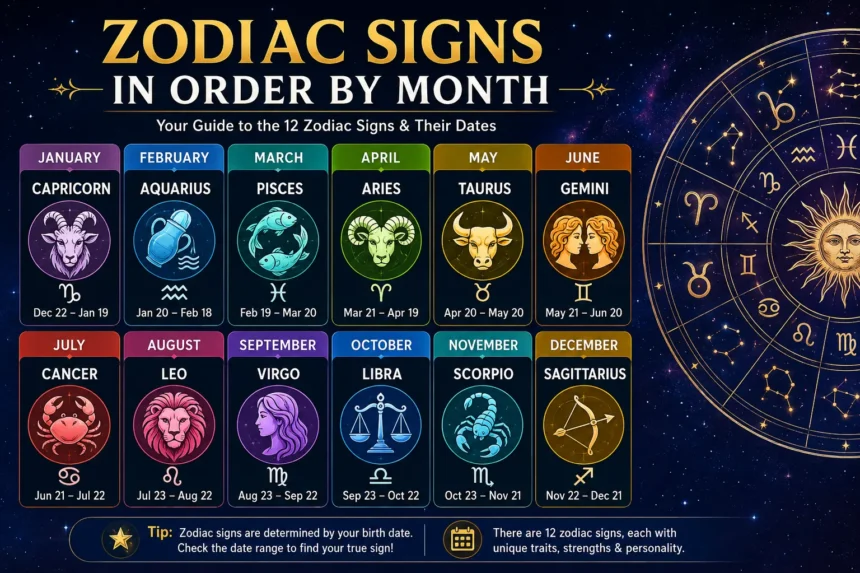
The 12 zodiac signs form the foundation of Western astrology, creating a cycle that runs from Aries to Pisces. Each sign has a commonly used date range, a distinctive symbol, and one of four traditional elements: Fire, Earth, Air, or Water. Together, these features provide a simple way to understand how the zodiac is organized.
Whether you are checking your sign for the first time, comparing two birthdays, or learning more about astrology, knowing the signs in order makes the rest of the zodiac much easier to understand. This guide covers all 12 zodiac signs with their commonly used dates, symbols, elements, traditional characteristics, and place in the zodiac sequence. It also explains why dates can vary slightly and how Western astrology differs from other astrological traditions.
The 12 Zodiac Signs at a Glance
Here is a quick reference to the zodiac signs from Aries to Pisces:
| # | Zodiac Sign | Common Dates | Symbol | Element |
| 1 | Aries | March 21 – April 19 | ♈ Ram | Fire |
| 2 | Taurus | April 20 – May 20 | ♉ Bull | Earth |
| 3 | Gemini | May 21 – June 20 | ♊ Twins | Air |
| 4 | Cancer | June 21 – July 22 | ♋ Crab | Water |
| 5 | Leo | July 23 – August 22 | ♌ Lion | Fire |
| 6 | Virgo | August 23 – September 22 | ♍ Maiden | Earth |
| 7 | Libra | September 23 – October 22 | ♎ Scales | Air |
| 8 | Scorpio | October 23 – November 21 | ♏ Scorpion | Water |
| 9 | Sagittarius | November 22 – December 21 | ♐ Archer | Fire |
| 10 | Capricorn | December 22 – January 19 | ♑ Sea-Goat | Earth |
| 11 | Aquarius | January 20 – February 18 | ♒ Water-Bearer | Air |
| 12 | Pisces | February 19 – March 20 | ♓ Fish | Water |
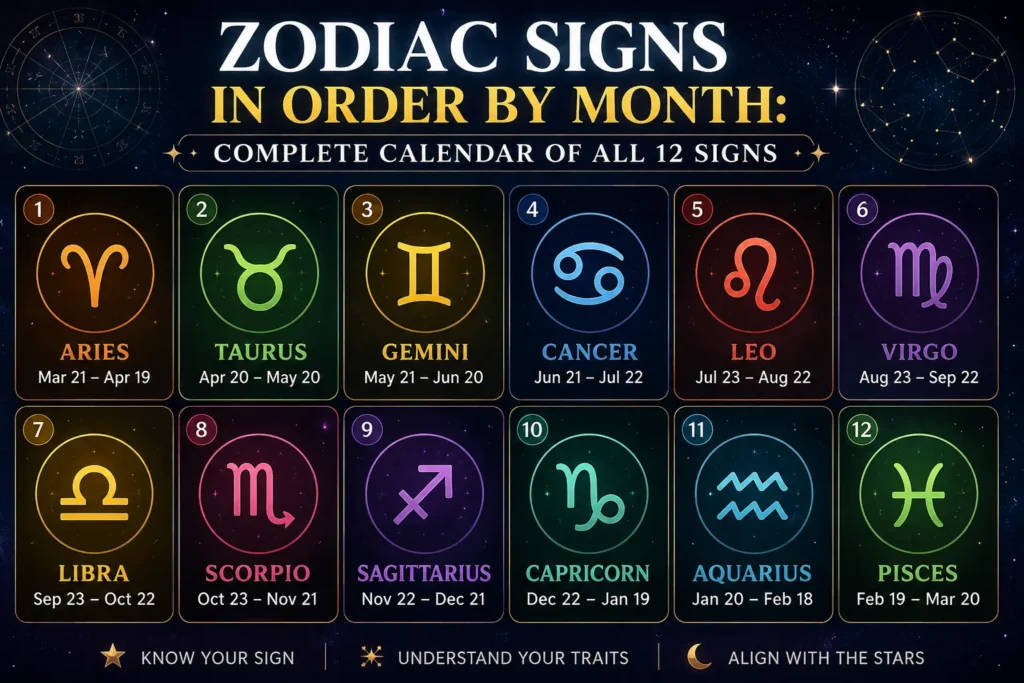
Important: These are commonly published date ranges for the Western tropical zodiac. The exact moment the Sun changes signs varies by year and time zone, so people born near a transition may need their exact birth information to determine their Sun sign.
What Are the 12 Zodiac Signs?
The zodiac is traditionally divided into 12 signs, each occupying a section of the zodiac used in Western astrology.
The sequence begins with Aries and continues through Pisces:
Aries → Taurus → Gemini → Cancer → Leo → Virgo → Libra → Scorpio → Sagittarius → Capricorn → Aquarius → Pisces
After Pisces, the cycle begins again with Aries.
Each sign has its own:
- Date range
- Symbol
- Element
- Traditional astrological associations
- Position in the zodiac sequence
The four elements—Fire, Earth, Air, and Water—each correspond to three zodiac signs.
1. Aries ♈ — The Ram
Common dates: March 21 – April 19
Element: Fire
Symbol: Ram
Zodiac position: First
Aries begins the traditional Western zodiac cycle.
In astrology, Aries is traditionally associated with action, initiative, confidence, independence, and enthusiasm. Its Ram symbol reflects the sign’s traditional connection with determination and forward movement.
Aries Element: Fire
Fire signs are traditionally associated with energy, expression, enthusiasm, and action. Aries is one of three Fire signs, alongside Leo and Sagittarius.
Aries at a glance
- Strengths traditionally associated: Courage, initiative, enthusiasm
- Common theme: Taking action
- Element group: Fire
2. Taurus ♉ — The Bull
Common dates: April 20 – May 20
Element: Earth
Symbol: Bull
Zodiac position: Second
Taurus follows Aries and is the second sign in the zodiac.
Traditional astrology associates Taurus with stability, patience, persistence, practicality, and appreciation for comfort and physical surroundings.
Taurus Element: Earth
Earth signs are traditionally connected with practicality, stability, groundedness, and material concerns.
Taurus shares the Earth element with Virgo and Capricorn.
Taurus at a glance
- Strengths traditionally associated: Patience, persistence, dependability
- Common theme: Stability
- Element group: Earth
3. Gemini ♊ — The Twins
Common dates: May 21 – June 20
Element: Air
Symbol: Twins
Zodiac position: Third
Gemini is the third zodiac sign and follows Taurus.
The Twins symbol is traditionally associated with Gemini’s themes of duality, communication, curiosity, and exchange of ideas.
Gemini Element: Air
Air signs are traditionally associated with communication, intellect, ideas, and social interaction.
Gemini belongs to the Air element along with Libra and Aquarius.
Gemini at a glance
- Strengths traditionally associated: Curiosity, adaptability, communication
- Common theme: Learning and exchange
- Element group: Air
4. Cancer ♋ — The Crab
Common dates: June 21 – July 22
Element: Water
Symbol: Crab
Zodiac position: Fourth
Cancer is the fourth sign of the zodiac.
Traditional astrological descriptions often associate Cancer with emotional awareness, nurturing, protectiveness, family, and connection to home.
Cancer Element: Water
Water signs are traditionally associated with emotions, intuition, sensitivity, and depth.
Cancer shares the Water element with Scorpio and Pisces.
Cancer at a glance
- Strengths traditionally associated: Caring, protective, intuitive
- Common theme: Emotional connection
- Element group: Water
5. Leo ♌ — The Lion
Common dates: July 23 – August 22
Element: Fire
Symbol: Lion
Zodiac position: Fifth
Leo is the fifth zodiac sign.
The Lion is traditionally connected with courage, confidence, creativity, warmth, and self-expression.
Leo Element: Fire
As a Fire sign, Leo is traditionally associated with enthusiasm, creativity, confidence, and expressive energy.
Leo shares this element with Aries and Sagittarius.
Leo at a glance
- Strengths traditionally associated: Creativity, confidence, generosity
- Common theme: Self-expression
- Element group: Fire
6. Virgo ♍ — The Maiden
Common dates: August 23 – September 22
Element: Earth
Symbol: Maiden
Zodiac position: Sixth
Virgo is the sixth zodiac sign and follows Leo.
Traditional astrology often describes Virgo through themes of organization, analysis, practicality, precision, and attention to detail.
Virgo Element: Earth
Virgo belongs to the Earth element, which is traditionally associated with practical thinking and grounded approaches.
Its fellow Earth signs are Taurus and Capricorn.
Virgo at a glance
- Strengths traditionally associated: Organization, practicality, analysis
- Common theme: Refinement and detail
- Element group: Earth
7. Libra ♎ — The Scales
Common dates: September 23 – October 22
Element: Air
Symbol: Scales
Zodiac position: Seventh
Libra is the seventh sign of the zodiac.
Unlike most zodiac symbols, Libra is represented by an object: the Scales. Traditional astrology connects Libra with balance, cooperation, diplomacy, relationships, and harmony.
Libra Element: Air
Libra is an Air sign, alongside Gemini and Aquarius.
Air signs are traditionally linked with communication, thought, social interaction, and ideas.
Libra at a glance
- Strengths traditionally associated: Diplomacy, cooperation, social awareness
- Common theme: Balance
- Element group: Air
8. Scorpio ♏ — The Scorpion
Common dates: October 23 – November 21
Element: Water
Symbol: Scorpion
Zodiac position: Eighth
Scorpio occupies the eighth position in the zodiac.
Traditional astrological descriptions often connect Scorpio with intensity, determination, emotional depth, focus, loyalty, and transformation.
Scorpio Element: Water
Scorpio is a Water sign with Cancer and Pisces.
Water signs are traditionally associated with feelings, intuition, sensitivity, and emotional depth.
Scorpio at a glance
- Strengths traditionally associated: Determination, focus, loyalty
- Common theme: Depth and transformation
- Element group: Water
9. Sagittarius ♐ — The Archer
Common dates: November 22 – December 21
Element: Fire
Symbol: Archer
Zodiac position: Ninth
Sagittarius is the ninth sign of the zodiac.
The Archer symbol is traditionally associated with exploration, learning, freedom, adventure, and the search for broader understanding.
Sagittarius Element: Fire
Sagittarius belongs to the Fire element along with Aries and Leo.
Fire signs are traditionally associated with enthusiasm, action, confidence, and expression.
Sagittarius at a glance
- Strengths traditionally associated: Optimism, curiosity, adventurousness
- Common theme: Exploration
- Element group: Fire
10. Capricorn ♑ — The Sea-Goat
Common dates: December 22 – January 19
Element: Earth
Symbol: Sea-Goat
Zodiac position: Tenth
Capricorn is the tenth sign in the zodiac.
Its traditional symbol is the Sea-Goat, a mythical creature combining features of a goat and a fish. Capricorn is traditionally associated with discipline, responsibility, ambition, persistence, and long-term goals.
Capricorn Element: Earth
Capricorn belongs to the Earth element alongside Taurus and Virgo.
Earth signs are traditionally connected with practicality, structure, stability, and persistence.
Capricorn at a glance
- Strengths traditionally associated: Discipline, persistence, responsibility
- Common theme: Long-term achievement
- Element group: Earth
11. Aquarius ♒ — The Water-Bearer
Common dates: January 20 – February Zodiac 18
Element: Air
Symbol: Water-Bearer
Zodiac position: Eleventh
Aquarius is the eleventh sign.
One of the most common points of confusion about Aquarius is its element. Although its symbol is the Water-Bearer, Aquarius is traditionally an Air sign, not a Water sign.
Traditional astrology associates Aquarius with independence, originality, ideas, innovation, and unconventional thinking.
Aquarius Element: Air
Aquarius belongs to the Air element alongside Gemini and Libra.
Aquarius at a glance
- Strengths traditionally associated: Originality, independence, innovation
- Common theme: Ideas and individuality
- Element group: Air
12. Pisces ♓ — The Fish
Common dates: February 19 – March 20
Element: Water
Symbol: Fish
Zodiac position: Twelfth
Pisces is the final sign in the traditional Western zodiac sequence.
Its symbol features two fish, and traditional astrology associates Pisces with imagination, sensitivity, compassion, intuition, and creativity.
Pisces Element: Water
Pisces belongs to the Water element with Cancer and Scorpio.
Water signs are traditionally associated with emotions, intuition, sensitivity, and depth.
Pisces at a glance
- Strengths traditionally associated: Compassion, imagination, creativity
- Common theme: Sensitivity and intuition
- Element group: Water
Zodiac Signs by Element
The four traditional elements provide another way to organize the 12 zodiac signs.
| Element | Zodiac Signs | Traditional Themes |
| Fire | Aries, Leo, Sagittarius | Energy, action, enthusiasm |
| Earth | Taurus, Virgo, Capricorn | Stability, practicality, grounding |
| Air | Gemini, Libra, Aquarius | Ideas, communication, social interaction |
| Water | Cancer, Scorpio, Pisces | Emotion, intuition, sensitivity |
Each element contains three signs.
For example, if someone is an Aries, Leo, or Sagittarius, their Sun sign belongs to the Fire element. If they are Taurus, Virgo, or Capricorn, their sign belongs to Earth.
These descriptions represent traditional astrological interpretations, not scientifically established personality categories.
Zodiac Signs by Symbol
The symbols make the 12 zodiac signs easy to recognize:
| Zodiac Sign | Symbol | Represents |
| Aries | ♈ | Ram |
| Taurus | ♉ | Bull |
| Gemini | ♊ | Twins |
| Cancer | ♋ | Crab |
| Leo | ♌ | Lion |
| Virgo | ♍ | Maiden |
| Libra | ♎ | Scales |
| Scorpio | ♏ | Scorpion |
| Sagittarius | ♐ | Archer |
| Capricorn | ♑ | Sea-Goat |
| Aquarius | ♒ | Water-Bearer |
| Pisces | ♓ | Fish |
Libra is distinctive because its symbol is the Scales, while Aquarius is notable because its Water-Bearer symbol does not make it a Water sign.
How to Find Your Zodiac Sign
Finding your zodiac sign is simple for most birthdays.
Step 1: Check your birthday
You need your month and day of birth.
Step 2: Match it to a date range
Use the zodiac table at the beginning of this article.
For example, someone born on May 10 falls within the commonly used Taurus range, so their Western tropical Sun sign is generally Taurus.
Someone born on November 30 falls within the Sagittarius range.
Step 3: Be careful with transition dates
If you were born right around the beginning or end of a sign’s range, a generic chart may not be enough.
The exact Sun-sign transition depends on the year and time zone. In those cases, an accurate birth-chart calculation using your birth date, exact birth time, and birthplace is the better approach.
Why Zodiac Sign Dates Can Vary
You may see slightly different zodiac dates across websites. This happens because the Sun does not enter each zodiac sign at precisely the same clock time every year.
Time zones can also affect the calendar date on which a transition appears.
For someone born well inside a sign’s commonly published range, this difference usually does not create confusion. It matters most for people born very close to a sign boundary.
Western Zodiac vs. Vedic Astrology
The zodiac system matters when identifying a person’s sign.
This article uses the Western tropical zodiac, which is the basis for the familiar Aries-to-Pisces date ranges commonly used in Western horoscope content.
Vedic astrology, widely practiced in India, generally uses a sidereal zodiac. Because the two systems use different reference points, a person’s sign can sometimes be labeled differently in Western and Vedic astrology.
If you are checking your zodiac sign from India, always confirm which astrological system a website or calculator is using.
Are Zodiac Signs Scientific?
Zodiac signs are part of an astrological tradition, not a scientifically established method of measuring personality or predicting future events.
The dates, symbols, elements, and sequence described in this article are factual descriptions of how the Western tropical zodiac is traditionally organized. Personality traits associated with each sign should be understood as traditional astrological interpretations rather than scientific findings.
Keeping this distinction clear helps readers explore astrology without confusing it with scientific research.
A Simple Way to Remember the 12 Zodiac Signs
If you find the 12-sign sequence difficult to memorize, divide it into four groups of three based on their elements:
Fire
Aries → Leo → Sagittarius
Earth
Taurus → Virgo → Capricorn
Air
Gemini → Libra → Aquarius
Water
Cancer → Scorpio → Pisces
Another easy method is to memorize the standard sequence in groups:
Aries, Taurus, Gemini
Cancer, Leo, Virgo
Libra, Scorpio, Sagittarius
Capricorn, Aquarius, Pisces
Once the sequence is familiar, identifying a sign by its position becomes much easier.
Frequently Asked Questions
What are the 12 zodiac signs in order?
The 12 zodiac signs in order are Aries, Taurus, Gemini, Cancer, Leo, Virgo, Libra, Scorpio, Sagittarius, Capricorn, Aquarius, and Pisces. Aries is first and Pisces is twelfth in the traditional Western zodiac sequence.
What are the zodiac signs and their dates?
The commonly used Western tropical ranges are Aries (March 21–April 19), Taurus (April 20–May 20), Gemini (May 21–June 20), Cancer (June 21–July 22), Leo (July 23–August 22), Virgo (August 23–September 22), Libra (September 23–October 22), Scorpio (October 23–November 21), Sagittarius (November 22–December 21), Capricorn (December 22–January 19), Aquarius (January 20–February 18), and Pisces (February 19–March 20). Exact transition dates can vary by year and time zone.
What are the four zodiac elements?
The four traditional zodiac elements are Fire, Earth, Air, and Water. Fire includes Aries, Leo, and Sagittarius; Earth includes Taurus, Virgo, and Capricorn; Air includes Gemini, Libra, and Aquarius; and Water includes Cancer, Scorpio, and Pisces.
Which zodiac sign comes after Aries?
Taurus comes after Aries in the traditional zodiac sequence. Aries is the first sign, followed by Taurus, Gemini, Cancer, Leo, Virgo, Libra, Scorpio, Sagittarius, Capricorn, Aquarius, and Pisces.
Why is Aquarius an Air sign if it represents water?
Aquarius is traditionally classified as an Air sign despite being represented by the Water-Bearer. The symbol refers to the figure carrying or pouring water, while the elemental classification belongs to the astrological system rather than being determined by the symbol itself.
Can zodiac dates change from year to year?
Yes, the exact moment when the Sun moves from one zodiac sign to another can vary from year to year. This is particularly important for people born near a transition date, who may need their exact birth time and location to determine their Sun sign.
Conclusion
The 12 zodiac signs from Aries to Pisces create the basic sequence used in Western tropical astrology. Each sign has a commonly used date range, a recognizable symbol, and a traditional elemental classification.
The key details to remember are:
- Aries begins the zodiac sequence.
- Pisces completes the cycle.
- There are 12 signs and four traditional elements.
- Fire, Earth, Air, and Water each contain three signs.
- Zodiac dates are useful for identifying a Sun sign but can require greater precision near sign transitions.
- Western tropical astrology and Vedic sidereal astrology may produce different sign results for the same birthday.
If you’re building your astrology knowledge, a natural next step is to explore zodiac compatibility, zodiac personality traits, Moon signs, Ascendants, and the meaning of each zodiac symbol.