

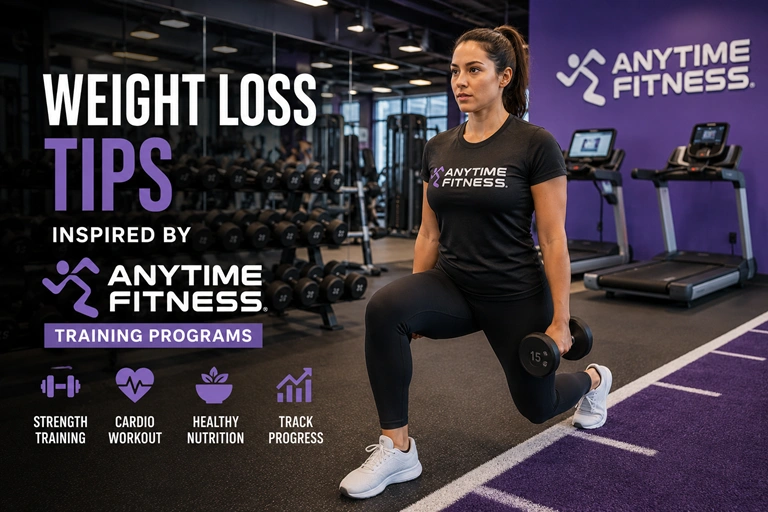
Walking into a gym with a weight-loss goal is easy. Knowing what to do once you get there is the harder part. Should you spend an hour on the treadmill, lift weights, attend a group session, or completely change your diet? The training philosophy used by Anytime Fitness offers a useful answer: combine strength, cardiovascular exercise, nutrition, recovery and accountability instead of relying on one “fat-burning” workout.
That approach also lines up with broader evidence-based guidance. Healthy weight loss is generally built around a sustainable eating pattern, regular physical activity, adequate sleep and manageable lifestyle changes—not extreme workouts or crash diets.
Quick Summary: Weight Loss Tips to Remember
- Combine strength training and cardiovascular exercise rather than choosing only one.
- Build a calorie deficit through sustainable eating habits and regular movement.
- Prioritize protein-rich, minimally processed foods and sensible portions.
- Use progressive training instead of doing the same workout every week.
- Track more than body weight: strength, measurements, activity and consistency also matter.
- Treat sleep and recovery as part of the program, not time wasted away from the gym.
- Use coaching or accountability when motivation alone is not enough.
- Aim for gradual, sustainable progress instead of trying to lose weight as quickly as possible.
Why the Anytime Fitness Approach Can Work for Weight Loss
The most useful lesson from Anytime Fitness training programs is not a particular exercise. It is the structure behind the training.
Anytime Fitness describes its AF Training approach around several components, including muscle development, cardiovascular training, physical and mental health, program variety and progress measurement. Its personal-training model can also incorporate individualized workouts, nutrition and recovery guidance, warm-ups, coaching and accountability.
That matters because weight loss is rarely a single-variable problem.
Imagine someone who burns plenty of calories during weekend workouts but spends most of the week sitting, eats large portions after training and sleeps five hours a night. Adding even more cardio may not solve the underlying problem.
A better strategy is to create a routine that can survive ordinary life.
Start with a measurable goal
“Lose weight” is a destination, not a useful weekly instruction.
A more practical target could be exercising three or four times per week, completing two strength sessions, walking regularly and improving food choices at most meals. The scale can still be monitored, but it should not be the only measure of progress.
The CDC notes that gradual weight loss—roughly 1 to 2 pounds per week for many adults—is more likely to be maintained than very rapid weight loss. Individual results vary, however, and factors such as medications, medical conditions, age, hormones, stress and genetics can influence weight management.
1. Make Strength Training a Core Part of Your Weight-Loss Plan
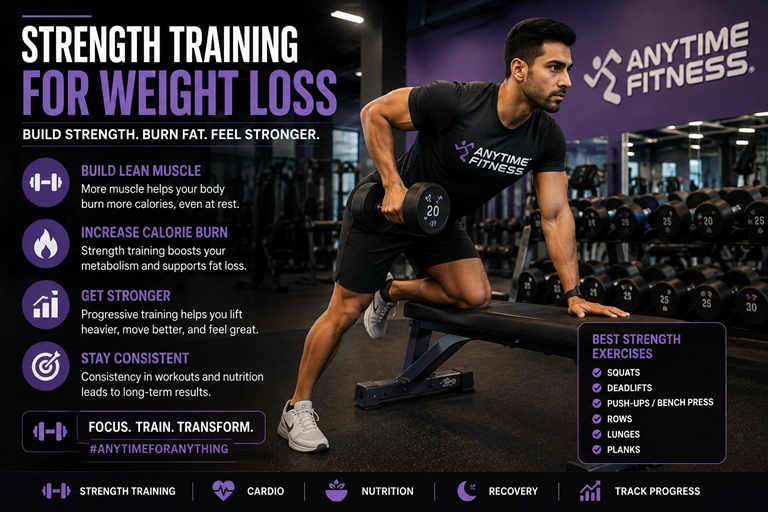
One common mistake is assuming that cardio should dominate every weight-loss workout.
Strength training deserves a permanent place in the schedule.
Resistance exercises challenge major muscle groups and can help maintain muscle mass while you are losing weight. NIDDK specifically notes that muscle-strengthening activity may help maintain muscle mass during weight loss.
An Anytime Fitness-inspired routine could therefore include exercises such as:
- Squats or leg presses
- Romanian deadlifts or hip hinges
- Chest presses or push-ups
- Lat pulldowns or assisted pull-ups
- Seated rows
- Shoulder presses
- Lunges or split squats
- Planks and other core exercises
You do not need to perform every exercise in every session. A beginner could start with a full-body routine two or three times per week, focusing on controlled technique and gradually increasing resistance.
Why progressive training matters
Doing the exact same workout with the same weight for months may eventually produce less of a training stimulus.
Progressive overload does not necessarily mean lifting extremely heavy weights. Progress can come from adding a few repetitions, increasing resistance slightly, improving technique, increasing range of motion or performing the exercise with better control.
This is one reason personalized coaching can be valuable. Anytime Fitness says its personal-training programs are designed around individual goals and can become progressively more challenging as the member develops.
For weight loss, the objective is not simply to become exhausted. The objective is to build a training routine that you can progressively improve.
2. Combine Cardio With Resistance Training
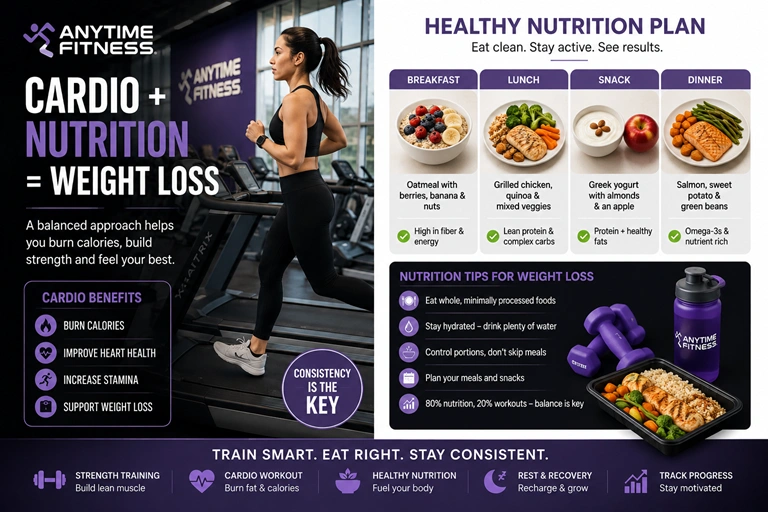
Cardio still matters. The trick is not treating it as the entire solution.
Brisk walking, cycling, jogging, swimming, rowing and other aerobic activities increase energy expenditure and contribute to cardiovascular fitness. The CDC recommends that adults get at least 150 minutes of moderate-intensity aerobic activity each week, along with muscle-strengthening activity on at least two days.
That creates plenty of flexibility.
A person who dislikes running does not need to force themselves onto a treadmill every day. A brisk outdoor walk can count. Cycling can count. A group fitness class can provide another option.
A practical weekly structure
A beginner might organize the week like this:
Monday: Full-body strength training
Tuesday: 30–40 minutes brisk walking
Wednesday: Rest or light mobility
Thursday: Full-body strength training
Friday: Moderate cardio
Saturday: Longer walk, recreational activity or group workout
Sunday: Rest and recovery
This is only an example, not a universal prescription. Training frequency should match your fitness level, schedule, recovery capacity and goals.
The larger principle is simple: combine resistance training with aerobic movement instead of trying to make every workout identical.
3. Treat Nutrition as Part of the Training Program
A hard gym session does not automatically cancel out a high-calorie diet.
The CDC explains that weight loss generally occurs when energy expenditure from activity is combined with a reduction in calories consumed. It also emphasizes that most weight loss comes from reducing calorie intake, while regular physical activity is particularly important for health and maintaining weight loss.
That does not mean you need to live on tiny portions or eliminate carbohydrates.
Instead, build meals around foods that provide good nutrition and help control hunger.
A practical plate might include:
- A substantial serving of vegetables
- A protein source such as eggs, fish, chicken, yogurt, beans, lentils or tofu
- A sensible portion of rice, oats, potatoes or whole grains
- Fruit as part of the day’s food intake
- Healthy fats in moderate portions
NIDDK recommends eating patterns that include vegetables, whole fruits, whole grains and varied protein sources while maintaining an appropriate calorie intake.
Don’t turn one meal into a failure
Suppose you eat pizza with friends on Saturday evening.
That meal does not erase an entire week of sensible eating.
The problem usually comes when one indulgent meal becomes an indulgent weekend, followed by an “I will restart Monday” mentality. Sustainable weight management is much easier when occasional higher-calorie meals are treated as part of normal life rather than as a reason to abandon the plan.
4. Use Accountability Instead of Depending on Motivation
Motivation feels great when it is high. Unfortunately, it is not consistent.
Accountability can be much more dependable.
This is one area where the Anytime Fitness training model is particularly relevant. Its personal-training offering emphasizes individualized programming, coaching and accountability, while its broader training approach includes support from coaches and the fitness community.
A coach can help answer questions that beginners frequently struggle with:
- Am I using the correct exercise technique?
- Is my workout actually progressing?
- Should I increase the weight?
- Am I doing too much cardio?
- How should I structure my week?
- What should I change when progress stalls?
You do not necessarily need a personal trainer forever. Even a period of structured coaching can teach you how to exercise with better technique and create a repeatable routine.
If professional coaching is not part of your budget, accountability can also come from a workout partner, group class, training log or simple weekly checklist.
The key is having something that makes consistency visible.
5. Don’t Ignore Recovery, Sleep and Daily Movement
There is a temptation to think that more exercise automatically means faster weight loss.
Not always.
Recovery affects how well you can train repeatedly. If every workout leaves you exhausted and you are sleeping poorly, maintaining the routine becomes harder.
Anytime Fitness includes recovery guidance as part of its training framework, alongside training and nutrition.
Sleep also belongs in the weight-management conversation. The CDC lists adequate sleep and stress management among the lifestyle factors that support healthy weight management.
Then there is the movement people often overlook: everything outside the gym.
Walking to a shop, taking stairs, doing household work or taking a short walk after dinner can add meaningful activity to the day. The CDC notes that activity can be accumulated in practical ways, rather than requiring every minute to happen in a formal workout.
For someone with a desk job, increasing daily movement may be more realistic than adding another exhausting gym session.
6. Track Progress Like a Training Project
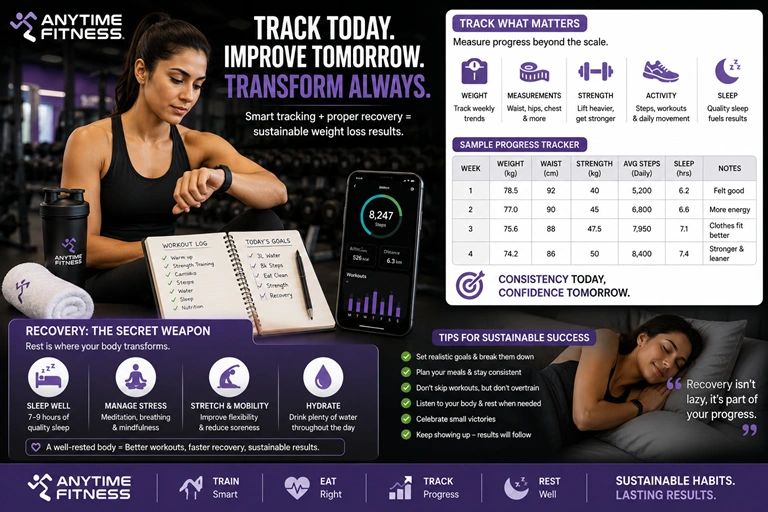
The scale is useful, but it tells only one part of the story.
A person can lose body fat while gaining or maintaining muscle, meaning the scale may move more slowly than expected. That is why a sensible weight-loss plan should track several indicators.
Consider recording:
- Body weight under consistent conditions
- Waist measurement
- Workout frequency
- Strength or repetitions
- Daily steps or general activity
- Sleep duration
- How consistently you follow your eating plan
Progress measurement is also one of the principles highlighted by Anytime Fitness’ AF Training framework.
What if your weight stops changing?
First, don’t immediately assume the program has failed.
Check your food portions, weekend eating, activity level and training consistency. Weight can also fluctuate because of hydration, food intake and other short-term factors.
If a genuine plateau continues, adjusting the overall plan may make sense. The change should be measured rather than extreme.
For example, someone might discover that they have gradually stopped walking as much as they did at the beginning of their program. Restoring that daily activity could be more useful than adding punishing cardio sessions.
A Simple Anytime Fitness-Inspired Weight-Loss Workout Framework
For someone starting from a relatively low fitness base, a simple structure could look like this:
Workout A — Full Body
- 5–10 minutes dynamic warm-up
- Squat or leg press: 2–3 sets
- Chest press: 2–3 sets
- Lat pulldown: 2–3 sets
- Hip-hinge movement: 2–3 sets
- Core exercise: 2–3 sets
- 10–15 minutes moderate cardio
Workout B — Full Body
- 5–10 minutes warm-up
- Lunges or split squats: 2–3 sets
- Seated row: 2–3 sets
- Shoulder press: 2–3 sets
- Hamstring-focused exercise: 2–3 sets
- Core exercise: 2–3 sets
- 10–20 minutes moderate cardio
Performing these sessions on non-consecutive days gives many beginners a manageable foundation. As fitness improves, volume, resistance or exercise complexity can be adjusted.
This should not be treated as a personalized medical or training prescription. People with injuries, chronic conditions or significant health concerns should discuss appropriate exercise with a qualified healthcare professional before beginning or substantially increasing physical activity.
Frequently Asked Questions
What is the best Anytime Fitness workout for weight loss?
There is no single best workout for everyone. A strong starting point is a combination of resistance training and cardiovascular activity, supported by sustainable nutrition and regular recovery. Anytime Fitness also offers personalized training options based on individual goals.
Can strength training help with weight loss?
Yes. Strength training increases energy expenditure and can help maintain muscle mass during weight loss. It also improves strength and physical function. Combining resistance training with aerobic activity is a practical approach for many adults.
How much cardio should I do to lose weight?
Adults should generally aim for at least 150 minutes of moderate-intensity aerobic activity per week, plus muscle-strengthening activity on at least two days. Individual weight-loss needs vary, and nutrition remains an important part of the equation.
How quickly should I expect to lose weight?
A gradual rate is generally more sustainable than rapid weight loss. The CDC cites about 1–2 pounds per week as a typical gradual range, but individual results vary considerably based on diet, activity, health, medications and other factors.
Conclusion
The most useful lesson from Anytime Fitness-style training is that weight loss should not revolve around one magical exercise. Build a system instead: strength training to support muscle and fitness, cardio and daily movement to increase activity, sensible nutrition to manage energy intake, and enough recovery to keep the routine sustainable.
The goal is not to have the hardest workout in the gym this week. It is to create a training and lifestyle pattern you can still follow months from now.