

India’s New Test Batters: Shubman Gill, Sai Sudharsan and Devdutt Padikkal
Shubman Gill has crossed an important line in his career.
For several years, the conversation around Gill was about potential. Was he the next great Indian opener? Could he become a reliable Test No. 3? Would his elegant strokeplay translate consistently across conditions?
Now the question is different.
How good can he become as India’s Test captain?
Gill was named captain for India’s 2026 Test tour of Sri Lanka, with KL Rahul as vice-captain. The BCCI’s original squad also included both Sai Sudharsan and Devdutt Padikkal, showing that the selectors were already viewing all three as part of the wider Test batting picture.
Gill’s Test record has given him the strongest foundation of the three. According to current career records, he has played 40 Tests and scored more than 2,800 runs, including 10 centuries.
That experience matters.
Test cricket is not just about technique. It is about knowing when a session is slipping away, when a bowler is tired, when to leave outside off stump and when to turn a defensive field into an attacking opportunity.
Gill has already experienced those situations.
What makes Shubman Gill valuable to India?
Gill’s greatest asset is arguably his range.
He can play conventional Test cricket when conditions demand patience, but he also has the ability to accelerate without completely abandoning his technique. That balance makes him particularly valuable in an Indian batting lineup that is moving into a new phase.
His leadership role adds another dimension.
A captain who bats in the top order carries a significant workload. Gill cannot simply focus on his own average. His innings often set the tone for an entire day’s play.
If he scores 150, India can potentially control a Test.
If he survives a difficult opening session and makes 70, he can still create the platform for someone else to dominate later.
That is the kind of responsibility that will define his next phase.
The real test for Gill
Gill no longer needs to prove that he belongs at international level.
He needs to prove that he can produce at a high level repeatedly.
The difference is subtle but enormous.
India will eventually judge his captaincy and batting together. A handful of spectacular innings will not be enough. The expectation will be regular runs, particularly against the strongest attacks and in overseas conditions.
That is the next chapter of the Shubman Gill Test career.
Sai Sudharsan: Is India’s patient left-hander still the long-term No. 3?
If Gill is the established centerpiece, Sai Sudharsan represents one of the most intriguing unfinished stories in India’s Test batting lineup.
Sudharsan has already shown why selectors are interested in him. He is left-handed, technically composed and comfortable building an innings rather than chasing the game.
Those qualities can be extremely valuable in Test cricket.
But his development has hit a temporary interruption.
The BCCI confirmed on August 9 that Sudharsan was ruled out of India’s Sri Lanka Test series because of a right-toe stress reaction. Sarfaraz Khan was named as his replacement.
That injury had an unexpected consequence: it created the opening through which Padikkal walked.
Why Sudharsan remains important
It would be easy to look at Padikkal’s century and immediately declare the No. 3 contest finished.
That would be premature.
Sudharsan had already been given responsibility in the Test lineup, and his underlying qualities remain attractive. His left-handed batting changes the angles for opposition bowlers and gives India variety at the top of the order.
His first-class background is another reason to keep faith.
Unlike a batter whose reputation has been built primarily on limited-overs cricket, Sudharsan has experience constructing long innings in domestic red-ball cricket. That foundation matters when the international game becomes unforgiving.
The key issue is conversion.
Sudharsan needs to turn promising starts into major Test scores. That is often the hardest transition for a young batter.
Getting to 50 proves you can survive.
Getting to 150 proves you can dominate a Test match.
Will Sai Sudharsan return to India’s Test XI?
There is every reason to expect him to remain in the selection conversation once fit.
The more interesting issue is whether he returns automatically.
Padikkal has changed the equation.
And that is one of the healthiest things that can happen to a Test team: two young batters competing for the same position because both have credible claims.
Devdutt Padikkal has changed the No. 3 conversation
Devdutt Padikkal did not simply fill in for an injured player.
He grabbed the opportunity.
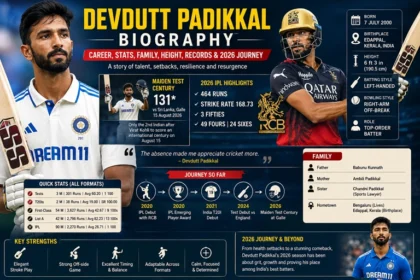
In the first Test against Sri Lanka in Galle, Padikkal scored his maiden Test century and went on to make 167, including 15 fours and a six. His innings helped India reach 460 for 9 and became one of the defining performances of the match.
The context makes the performance even more interesting.
Padikkal was brought into the playing XI after Sudharsan was ruled out. He had already scored an unbeaten 142 in India’s warm-up match against Sri Lanka Cricket XI, strengthening his case for a place in the Test side.
Then came Galle.
He was not overawed by the situation.
He did not try to manufacture a spectacular innings.
Instead, he settled in, handled the spin and built a substantial score.
That is precisely what selectors want from a young Test batter.
Why Padikkal’s Galle century matters
A maiden Test hundred is always significant.
But Padikkal’s 167 carries extra weight because of where he scored it and the role he was asked to perform.
He batted at No. 3, a position that demands concentration because the batter can arrive at the crease almost immediately after the opening partnership ends.
He also had to negotiate Sri Lanka’s spin options on a surface where the ball could grip and turn.
Reuters reported that Padikkal’s century was the major contributor to India’s 460 for 9 in the first Test, despite Sri Lanka’s spinners later fighting back.
That is not merely a “good debut” story.
It is a selection story.
Padikkal’s technique against spin
One of the most encouraging aspects of the innings was his footwork.
Reports from Galle highlighted his ability to use decisive movement against spin rather than becoming trapped on the crease.
That matters enormously for an Indian batter.
If Padikkal can consistently manipulate spin with his feet, defend with control and punish poor lengths, he has a skill set that could become particularly useful in Asian Test conditions.
His challenge now is simple:
Can he do it again?
One exceptional Test can transform a player’s reputation. Sustained performances transform a career.
Shubman Gill vs Sai Sudharsan vs Devdutt Padikkal: who is India’s best long-term option?
This is where the debate gets genuinely interesting.
There is no need to treat the three players as identical candidates. Their strengths are different.
| Player | Batting hand | Primary role | Biggest strength | Main question |
|---|---|---|---|---|
| Shubman Gill | Right-hand | Top-order batter/captain | Experience, range and leadership | Can he sustain elite consistency? |
| Sai Sudharsan | Left-hand | Top-order/No. 3 | Patience and technique | Can he convert starts into big scores? |
| Devdutt Padikkal | Left-hand | Top-order/No. 3 | Strokeplay and spin-handling | Can he reproduce his Galle impact? |
There is also an important tactical point here.
India does not necessarily have to choose between “good” and “bad.”
It may be choosing between different combinations.
If conditions favor a left-handed batter comfortable against spin, Padikkal or Sudharsan could be particularly useful. If India wants continuity and leadership, Gill is the obvious anchor.
The eventual batting order could therefore be shaped by conditions, form and opposition rather than rigid hierarchy.
What does India’s Test batting lineup look like in 2026?
India’s Test batting group is entering an interesting transition.
The 2026 Sri Lanka squad originally named Gill, Rahul, Jaiswal, Rishabh Pant, Sudharsan and Padikkal among the batting options. Sudharsan’s injury subsequently changed the composition, while Padikkal earned a place in the XI.
That depth is significant.
India now has several players capable of competing for top-order positions rather than relying on one obvious succession path.
A possible long-term structure
One possible framework could involve:
Yashasvi Jaiswal
An aggressive left-handed opener who can put pressure on attacks immediately.
Shubman Gill
The established right-hander and Test captain.
Sai Sudharsan / Devdutt Padikkal
Two left-handed candidates with different but complementary strengths.
Middle order
Supported by experienced players and India’s increasingly deep wicketkeeping and all-round options.
The exact combination will change.
That is normal.
What matters is whether India can develop a core that survives the inevitable changes in form, fitness and conditions that define a Test season.
Why India needs more than one young Test batting star
There is a tendency in cricket to search for “the next Virat Kohli” or “the next Rahul Dravid.”
That comparison is usually unhelpful.
Great teams are rarely built around one replacement.
They are built around combinations.
India needs several batters who can contribute in different ways:
- A player who can absorb pressure.
- A player who can counterattack.
- A batter comfortable against high-quality pace.
- Someone who can manipulate spin.
- A dependable player who can bat through an entire session.
- Someone capable of converting starts into match-defining hundreds.
Gill, Sudharsan and Padikkal offer different pieces of that puzzle.
That is why their development is more important than any individual comparison.
The Role of domestic cricket in India’s Test batting future
Padikkal’s emergence is also a reminder of something that often gets forgotten during international cricket’s busiest periods: red-ball preparation still matters.
A Test century is rarely created overnight.
The habits that allow a batter to survive 250 deliveries — leaving the ball, rotating strike, concentrating after lunch, rebuilding after a wicket — are generally developed through first-class cricket.
India’s domestic system continues to serve as the laboratory for those skills.
Padikkal’s rise through domestic cricket and his subsequent international opportunity provide a useful example of how that pathway can work.
For Sudharsan, too, first-class cricket remains a crucial part of his development.
The goal should not simply be producing players who can score quickly.
India needs batters who understand how to build Test innings.
What should India expect from Gill, Sudharsan and Padikkal next?
The answer is not “more centuries” — at least not only that.
India needs evidence that these players can adapt.
Against fast bowling
Gill has already accumulated significant international experience, while Sudharsan and Padikkal will need repeated exposure to high-quality pace in overseas conditions.
Against spin
Padikkal’s Galle innings was particularly encouraging because of how effectively he handled spin.
Sudharsan will need to demonstrate the same adaptability when he returns.
Under scoreboard pressure
This is perhaps the biggest test.
Can a young batter walk in at 20 for 2 and still produce a hundred?
Can he bat for two sessions after India loses three wickets?
Can he protect the tail?
Those situations define Test players.
Over an entire season
Consistency is the final filter.
A good Test player needs to perform when conditions are perfect and when nothing seems to be going right.
That is where Gill has an obvious advantage in experience.
India’s biggest No. 3 selection battle may be a good thing
The Padikkal-Sudharsan debate should not necessarily be framed as one player’s success being another player’s failure.
It can be the opposite.
Competition raises standards.
If Sudharsan returns and scores heavily, Padikkal knows he must continue producing. If Padikkal maintains his form, Sudharsan has an incentive to sharpen his game further.
For India, that means greater depth.
Recent reporting from India’s Sri Lanka campaign has also emphasized that the team management views both young left-handers as potential long-term assets rather than treating Padikkal’s breakthrough as an automatic end to Sudharsan’s prospects.
That is the sensible approach.
Test careers are long.
Form comes and goes.
Injuries happen.
A squad capable of producing two or three credible candidates for the same position is far stronger than one dependent on a single player.
India’s new Test batters : what happens next?
The immediate storyline is obvious.
Gill is the leader. Padikkal is the latest breakthrough performer. Sudharsan is the injured contender waiting to return.
But the larger story is much more significant.
India is building a new Test batting cycle.
Gill is already carrying responsibility.
Sudharsan is waiting for another opportunity to establish himself.
Padikkal has just given the selectors a reason to think very carefully before changing the No. 3 position again.
And there are other young players waiting behind them.
That is how strong Test teams are built.
Not through one perfect XI, but through competition for places.
India’s Test Batting Future: 5 Things to Watch
1. Can Gill turn leadership into sustained run-scoring?
Captaincy adds pressure. How Gill manages that workload will be central to India’s next Test cycle.
2. How does Sudharsan respond after injury?
His comeback could become one of the most important selection stories in India’s next Test assignment.
3. Can Padikkal back up his maiden century?
The second and third major innings after a breakthrough are often more revealing than the first.
4. Does India continue with a left-handed No. 3?
Both Sudharsan and Padikkal offer India a left-handed option, creating tactical flexibility.
5. Can the trio succeed overseas?
This is ultimately the biggest question.
India’s batting future will not be judged only by performances in familiar Asian conditions. England, Australia and South Africa will provide a different examination.
Frequently Asked Questions About India’s New Test Batters
Who are India’s new Test batters?
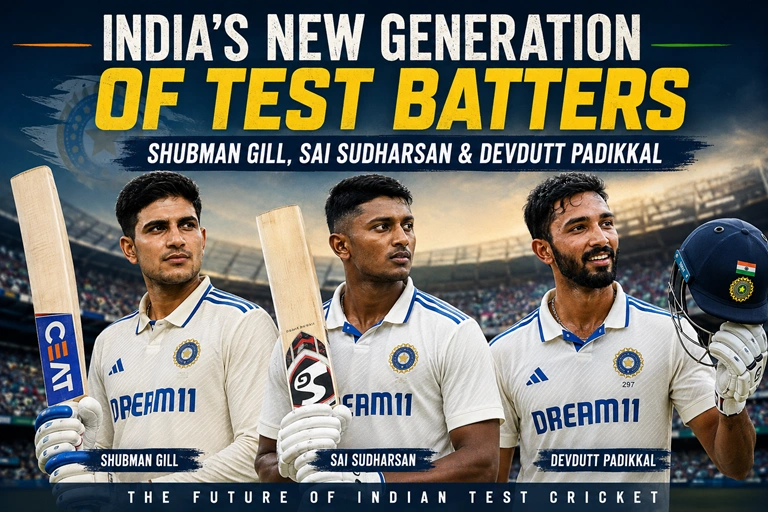
Shubman Gill, Sai Sudharsan and Devdutt Padikkal are among the most closely watched young or emerging members of India’s Test batting group. Gill is already an established international batter and captain, while Sudharsan and Padikkal are competing for long-term top-order roles.
Who is India’s Test captain in 2026?
Shubman Gill is India’s Test captain in 2026. He was named captain for the two-Test tour of Sri Lanka, with KL Rahul as vice-captain.
What is Devdutt Padikkal’s highest Test score?
As of August 20, 2026, Devdutt Padikkal’s highest Test score is 167, made against Sri Lanka in Galle. It was his maiden Test century and a defining performance in India’s first Test of the series.
Why was Sai Sudharsan not playing in the Sri Lanka Tests?
Sai Sudharsan was ruled out of the Sri Lanka Test series because of a right-toe stress reaction. The BCCI named Sarfaraz Khan as his replacement.
Is Devdutt Padikkal replacing Sai Sudharsan permanently?
Not necessarily. Padikkal’s Galle century has strengthened his case, but Sudharsan remains a serious long-term option. India’s eventual choice can depend on fitness, form, opposition and conditions.
Who should bat at No. 3 for India: Sai Sudharsan or Devdutt Padikkal?
There is no definitive answer yet. Padikkal has the immediate advantage of a major Test century in Galle, while Sudharsan had already been trusted with the role. The strongest approach may be to assess both over a longer sample rather than make the decision from one innings.
Is Shubman Gill part of India’s next Test generation?
Yes, although “young prospect” is no longer the right description. Gill is already an established Test batter and captain. His role is increasingly that of the senior figure around whom India’s next batting generation can develop.
Final Verdict: India has a selection problem worth having
India’s new Test batting generation does not yet have a finished identity.
That is precisely what makes it exciting.
Shubman Gill has the experience and leadership responsibility. Sai Sudharsan has the technique and patience to remain a serious long-term candidate. Devdutt Padikkal has just produced the sort of innings that forces selectors to reconsider assumptions.
The important thing now is not to crown one player after a single series.
Give them opportunities.
Give them challenging conditions.
Give them enough time to fail, learn and adapt.
Then judge them.
If Gill continues to lead from the front, Sudharsan converts his promise into major Test scores and Padikkal builds on his Galle breakthrough, India could have something every Test side wants: a deep, flexible and genuinely competitive batting core for the next generation.
And perhaps the most encouraging part is that the competition has already begun.