

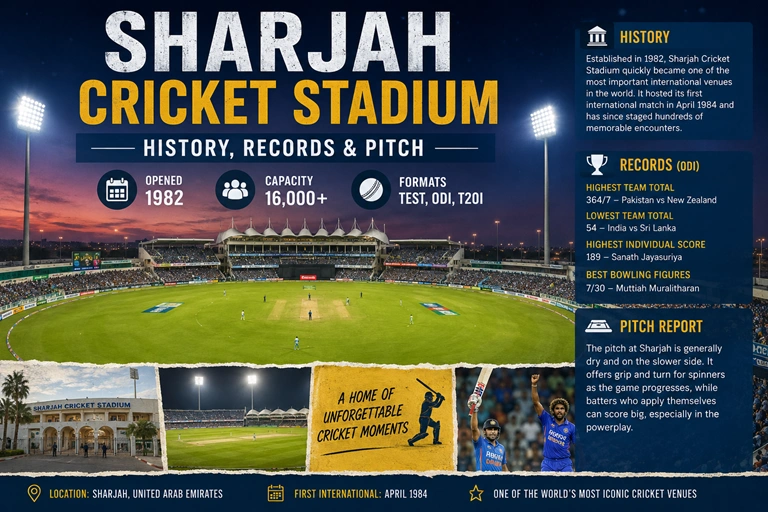
There are cricket grounds that become famous because of one tournament, one team or one unforgettable match. Sharjah Cricket Stadium is different. Its reputation was built over decades, particularly through the one-day cricket boom of the 1980s and 1990s. From Javed Miandad’s famous last-ball six against India to Sachin Tendulkar’s remarkable performances against Australia, Sharjah has been the backdrop to moments that still live in cricket conversations. The venue opened in 1982 and hosted its first international match in 1984, beginning one of the richest histories in UAE cricket.
Quick Summary
- Location: Sharjah, United Arab Emirates
- Opened: 1982
- First international cricket: April 1984
- Capacity: About 16,000
- Primary international formats: Tests, ODIs and T20Is
- Known for: A remarkable ODI history and iconic India-Pakistan encounters
- International cricket identity: One of the world’s most experienced limited-overs venues
- Current pitch character: Generally dry and capable of becoming slower as a match progresses
- Highest ODI team total: 364/7 by Pakistan against New Zealand
- Highest T20 team total: 215/6 by Afghanistan against Zimbabwe
- Famous ODI individual score: Sanath Jayasuriya’s 189 against India
- Best ODI bowling figures: Muttiah Muralitharan’s 7/30 against India
Records and venue statistics can change as new matches are played, so individual figures should be checked against the latest scorecards when publishing a frequently updated statistics page.
Sharjah Cricket Stadium History: How Did the Venue Become So Famous?
Sharjah Cricket Stadium’s story began in the early 1980s, at a time when one-day international cricket was rapidly expanding. The ground opened in 1982 and quickly became a regular destination for international limited-overs tournaments. Its first international cricket came in April 1984. The timing proved significant: one-day cricket was becoming increasingly popular, and Sharjah was perfectly placed to become a neutral meeting point for major cricketing nations.
The venue’s rise was closely connected with the cricketing communities living across the UAE. Large South Asian expatriate populations helped create an unusually passionate audience for matches involving India, Pakistan, Sri Lanka and other teams. Triangular tournaments became a familiar feature, and Sharjah developed a reputation for staging international cricket in a compact, atmospheric setting.
That history eventually produced an extraordinary statistical landmark. The ICC has described Sharjah as a venue that hosted more men’s ODIs than any other stadium in the world, while its 2021 historical overview noted that it had already hosted 240 men’s ODIs at that point.
The Javed Miandad Moment
One of Sharjah’s most famous scenes came in 1986 during an India-Pakistan match. Pakistan needed four runs from the final ball, and Javed Miandad struck Chetan Sharma for a six over the boundary. The finish became one of the defining moments in the history of India-Pakistan cricket.
It was not simply a dramatic finish. The setting mattered. Sharjah had already established itself as one of the principal neutral venues for South Asian cricket, and the match showed how much emotional weight the stadium could carry.
The incident remains part of the ground’s identity decades later. When people discuss Sharjah’s greatest cricket moments, Miandad’s six is almost impossible to leave out.
Sachin Tendulkar’s Sharjah Legacy
More than a decade later, Sachin Tendulkar produced another chapter in the stadium’s mythology. During the 1998 Coca-Cola Cup, Tendulkar scored back-to-back centuries against Australia, including the famous innings that helped India reach the final.
The 1998 tournament is particularly memorable because Tendulkar’s batting seemed to match the characteristics of the venue perfectly. He combined controlled stroke play with aggressive hitting, repeatedly putting pressure on the Australian attack.
The 1998 final added another memorable entry to Sharjah’s history. Tendulkar made 134 from 131 balls as India chased Australia’s 273 and won the Coca-Cola Cup. The ICC specifically highlights that performance among the venue’s landmark moments.
From Traditional ODIs to Modern T20 Cricket
Sharjah did not disappear when international cricket expanded to newer UAE venues. Instead, it adapted. The stadium has hosted Tests, ODIs and T20Is, along with major domestic and franchise competitions.
It was also used during the Indian Premier League’s UAE editions, adding another layer to its modern cricket identity. The venue has subsequently featured heavily in Afghanistan cricket, UAE cricket and international T20 tournaments.
That ability to move between eras is one reason Sharjah remains relevant. It is not merely a historic ground preserved in old highlight reels. It continues to host competitive cricket.
Sharjah Cricket Stadium Capacity, Location and Ground Details
The stadium is located in Sharjah, United Arab Emirates, and current venue information lists its capacity at approximately 16,000 spectators. It has floodlights and is listed with the Pavilion End and Sharjah Club End.
A 16,000-seat capacity may sound modest compared with some of the world’s giant cricket stadiums. Yet capacity is not the whole story. Sharjah’s importance comes from the concentration of history inside that relatively compact venue.
During major matches, the atmosphere can feel considerably larger than the official seating number suggests. The ground has spent decades hosting teams with enormous followings, particularly from South Asia. That combination of a relatively intimate stadium and high-profile fixtures has contributed to its distinctive character.
Why Sharjah Became an Important Neutral Venue
The UAE does not have the same long-established domestic cricket infrastructure as countries such as India, England or Australia. Sharjah’s early international success was therefore unusual.
Its location helped. The UAE became a convenient meeting point for teams and supporters, especially during periods when political, scheduling or logistical considerations made neutral venues attractive.
The stadium’s record of hosting international cricket across several decades turned it into something more than a local ground. It became part of the international cricket calendar.
The ICC’s historical material notes that Sharjah became a regular home for limited-overs tournaments as one-day cricket’s popularity surged during the 1980s.
Sharjah Cricket Stadium Records: ODI, T20I and Test Statistics
Sharjah’s long history naturally creates an enormous record book. The venue has produced everything from huge totals to spectacular collapses, and its statistics illustrate how dramatically conditions can vary.
Major ODI Records
Current venue statistics list the following major ODI figures:
| ODI Record | Sharjah Cricket Stadium |
|---|---|
| Highest team total | 364/7 – Pakistan vs New Zealand |
| Lowest team total | 54 all out – India vs Sri Lanka |
| Highest successful chase | 285/2 – Australia vs Pakistan |
| Highest individual score | 189 – Sanath Jayasuriya |
| Best bowling figures | 7/30 – Muttiah Muralitharan |
Pakistan’s 364/7 against New Zealand came in December 2014. Ahmed Shehzad scored 113 as Pakistan posted the venue’s highest ODI total, before bowling New Zealand out for 217 and winning by 147 runs.
At the other end of the scale is India’s 54 all out against Sri Lanka in 2000. The contrast between 364 and 54 tells you something useful about Sharjah: historical averages do not tell the entire story. A surface that can reward confident stroke play can also expose a batting lineup when bowlers hit the right areas.
Sanath Jayasuriya’s 189 against India in October 2000 remains one of the standout individual ODI innings at the ground. Muttiah Muralitharan’s 7/30 in the same period remains a benchmark bowling performance.
T20I Records at Sharjah
T20 cricket has given the stadium a new statistical identity.
Current venue records list 215/6 by Afghanistan against Zimbabwe as the highest T20 total at Sharjah. The lowest recorded T20 total in the available venue statistics is 38 all out, by Hong Kong against Pakistan.
That range is striking. A ground capable of producing a 200-plus T20 score can also produce a dramatic batting collapse.
This is partly why Sharjah remains an interesting venue for T20 cricket. Shorter boundaries can encourage attacking shots, but the surface does not always make clean hitting easy. Batters who swing hard without first judging the pace of the pitch can find themselves caught or bowled surprisingly quickly.
Test Cricket Records
Although Sharjah is most closely associated with limited-overs cricket, it has also hosted Test matches.
Current venue statistics list 690/10 by New Zealand against Pakistan as the highest Test total at Sharjah. The lowest is 53 all out by Pakistan against Australia. The ground has hosted nine men’s Tests.
The contrast again illustrates how different a cricket surface can become over the course of a match. A ground known today for T20 cricket has also witnessed long Test innings requiring patience and concentration.
Sharjah Cricket Stadium Pitch Report: Is It Batting or Bowling Friendly?
Ask whether Sharjah is a batting pitch or a bowling pitch and the honest answer is: it depends on the surface, match format and stage of the innings.
Traditionally, Sharjah has been associated with a relatively slow and low surface. Reports from matches at the venue have frequently described conditions in which the ball can skid or grip, while spin becomes increasingly relevant as the innings develops.
At the same time, the relatively compact boundary dimensions mean a batter who gets set can score quickly. That creates an interesting tactical tension.
The ground may look inviting for aggressive batting. The pitch may not always agree.
What Should Batters Expect?
The opening overs can offer a different challenge from the middle overs. With a newer ball, seamers may find some movement, especially if there is enough moisture or assistance in the surface.
Once batters understand the pace of the pitch, timing becomes more important than simply swinging harder.
This is where experienced players often separate themselves. They wait for the ball to come onto the bat, use the crease intelligently and target the shorter boundaries only when the shot is genuinely available.
In T20 cricket, a batter who survives the early period can potentially change the game very quickly. But mistiming is punished because a slower surface can make a well-struck-looking shot travel much shorter than expected.
How Do Spinners Perform at Sharjah?
Spin can become particularly influential in the middle overs.
The surface has traditionally been capable of offering grip and reduced pace, which gives spinners an opportunity to vary flight, pace and length. A bowler who repeatedly bowls the same pace can become predictable, while one who changes speed and attacks the stumps can create pressure.
That does not mean every Sharjah match automatically becomes a spin-dominated contest. The exact pitch matters. Recent venue reports have also described conditions in which pace bowlers receive useful assistance, particularly early in the innings.
What Is a Competitive Score at Sharjah?
There is no single magic number.
Venue statistics currently show an average first-innings score of around 223 in ODIs and 145 in T20 matches in the available overall data. Second-innings averages are lower, at roughly 190 in ODIs and 123 in T20 matches.
Those figures provide context, but they should not be treated as a guaranteed par score for every game.
Weather, pitch preparation, boundary dimensions, dew, opposition quality and the match situation can all shift the scoring pattern.
For a T20 match, a total around the mid-150s may be competitive on one day but inadequate on another. In an ODI, a score above 250 can create substantial pressure, particularly if the pitch slows down.
The smarter approach is to judge the pitch during the first innings rather than relying solely on historical averages.
Famous Matches and Moments at Sharjah Cricket Stadium
Statistics explain the venue, but famous matches explain why people remember it.
Sharjah has hosted an unusually large number of high-profile South Asian cricket contests. India-Pakistan games are particularly associated with the ground, but its history extends far beyond that rivalry.
Miandad’s Last-Ball Six
The 1986 India-Pakistan finish remains perhaps the most famous Sharjah moment.
Pakistan required four runs from the final delivery. Miandad cleared the boundary, turning a tense chase into an unforgettable finish.
For many fans, that six is shorthand for Sharjah itself.
Tendulkar vs Australia
Tendulkar’s 1998 performances against Australia created another defining chapter. His consecutive centuries during the Coca-Cola Cup are among the most celebrated batting displays in the stadium’s history.
The final was especially significant because Tendulkar’s 134 helped India chase 273 successfully.
Afghanistan’s Rise
Sharjah has also become increasingly important to Afghanistan cricket. The ground has hosted Afghanistan’s international matches and provided a familiar setting for a team that developed its international reputation rapidly.
One notable T20 World Cup performance came in 2021, when Afghanistan defeated Scotland by 130 runs. Afghanistan scored 190, while Scotland were bowled out for 60. Mujeeb Ur Rahman took five wickets for 20 runs on his T20 World Cup debut.
That match is a reminder that Sharjah’s story did not end with the golden era of 1980s and 1990s one-day cricket. New generations have created their own memories there.
Why Sharjah Cricket Stadium Still Matters
The easiest way to understand Sharjah’s importance is to look at its timeline.
The stadium emerged during the rise of one-day cricket. It became a neutral venue for major teams. It hosted iconic India-Pakistan contests. It witnessed Tendulkar’s greatest one-day performances. It broke records for ODI hosting. It later became a venue for T20 internationals, franchise cricket and Afghanistan’s rise.
Very few grounds have remained relevant through so many changes in the sport.
Modern cricket is faster, more analytical and increasingly shaped by T20 leagues. Yet Sharjah still rewards many of the same qualities that mattered decades ago: adaptability, awareness of conditions and the ability to manage pressure.
Its record book is equally revealing. A 364/7 ODI total and a 54 all-out collapse exist in the same venue history. A 189-run individual innings sits alongside a 7/30 bowling spell. Afghanistan’s 215/6 T20I record sits opposite a 38 all-out collapse.
That variety is part of Sharjah’s charm.
For spectators, the attraction is the history. For players, it is the challenge of adapting to a pitch that can change the rhythm of a match. For analysts, it is a venue where historical numbers provide useful clues but never tell the complete story.
Frequently Asked Questions
What is the capacity of Sharjah Cricket Stadium?
Sharjah Cricket Stadium has a listed capacity of approximately 16,000 spectators. The venue also features floodlights and is identified with the Pavilion End and Sharjah Club End.
When was Sharjah Cricket Stadium built?
Sharjah Cricket Stadium opened in 1982 and hosted its first international cricket in April 1984. It quickly became a major venue for limited-overs tournaments.
What is the highest ODI score at Sharjah Cricket Stadium?
The highest ODI team total listed for the venue is 364/7, scored by Pakistan against New Zealand in December 2014. Pakistan won that match by 147 runs.
Is Sharjah Cricket Stadium a batting or bowling pitch?
Sharjah can assist both disciplines. The surface is often described as dry, slow or low, giving spinners and change-of-pace bowlers opportunities, while the relatively compact boundaries reward settled batters.
Conclusion
Sharjah Cricket Stadium is more than an international cricket venue. It is a living record of how the game changed from the one-day boom of the 1980s to the T20 era.
Its 1982 opening, first international in 1984, iconic India-Pakistan finishes, Tendulkar’s 1998 heroics, remarkable ODI statistics and continuing role in T20 cricket have given it a place few grounds can match.
For anyone studying a match at Sharjah, the best practical lesson is simple: do not judge the venue by reputation alone. Check the current pitch, assess the pace of the surface, watch how the ball behaves early and then adjust expectations. Sharjah can reward aggression, but it often rewards intelligent batting even more.