

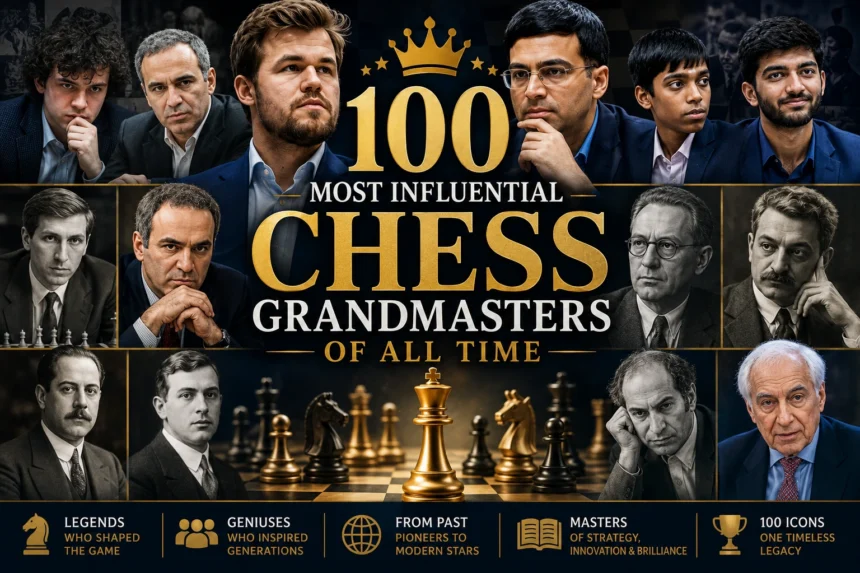
Very few sports have been shaped by individuals the way chess has. Every generation produces exceptional players, but only a select few change how the game is studied, played, and understood. Some revolutionized opening theory, others dominated world championships for years, while a handful inspired millions to pick up a chessboard for the first time. This editorial list celebrates the 100 Most Influential Chess Grandmasters—players whose achievements and lasting impact extend far beyond tournament victories.
Quick Summary
- Garry Kasparov and Magnus Carlsen headline the list due to their extraordinary dominance and influence.
- Bobby Fischer transformed chess in the Western world.
- Viswanathan Anand sparked India’s chess revolution.
- José Raúl Capablanca and Mikhail Botvinnik reshaped positional and scientific chess.
- Modern stars continue to influence millions through elite competition, streaming, books, and coaching.
What Makes a Chess Grandmaster Influential?
Winning tournaments is only one part of a player’s legacy. True influence comes from changing the game itself.
The grandmasters featured in this list have contributed through one or more of the following:
- World Championship victories
- Revolutionary opening ideas
- Endgame theory
- Books and coaching
- Inspiring future generations
- Popularizing chess globally
- Long-term dominance
- Contributions to computer-assisted chess
Some held the world title for years. Others never became world champion but still transformed how chess is played and studied.
Why These Players Changed Chess Forever
The history of chess is filled with remarkable champions, but influence often extends beyond trophies.
Take Bobby Fischer, for example. His victory in 1972 ignited worldwide interest in chess during the Cold War and inspired countless young players in the United States and beyond.
Similarly, Garry Kasparov’s rivalry with IBM’s Deep Blue forever changed how professionals prepared for games using computers.
Magnus Carlsen brought chess into the digital age, reaching millions through online tournaments, streaming platforms, and global media.
Viswanathan Anand transformed India from a country with one grandmaster into one of the world’s strongest chess nations.
These stories remind us that lasting influence often extends far beyond Elo ratings.
Top 25 Most Influential Chess Grandmasters
| Rank | Name | Country | Year Became GM | Notable Achievements | Significant Milestones |
| 1 | Garry Kasparov | Russia | 1980 | World Champion (1985–2000) | Revolutionized modern opening preparation |
| 2 | Magnus Carlsen | Norway | 2004 | Multiple-time World Champion | Highest Elo rating in history |
| 3 | Bobby Fischer | United States | 1958 | World Champion (1972) | Popularized chess globally during Cold War |
| 4 | Anatoly Karpov | Russia | 1970 | World Champion | Dominated elite chess for over a decade |
| 5 | Viswanathan Anand | India | 1988 | Five-time World Champion | Inspired India’s chess revolution |
| 6 | José Raúl Capablanca | Cuba | N/A* | World Champion | Legendary endgame mastery |
| 7 | Mikhail Botvinnik | Soviet Union | N/A* | Three-time World Champion | Founder of Soviet chess school |
| 8 | Emanuel Lasker | Germany | N/A* | World Champion (27 years) | Longest reign in chess history |
| 9 | Alexander Alekhine | France | N/A* | World Champion | Brilliant attacking style |
| 10 | Mikhail Tal | Latvia | 1957 | World Champion | Famous for creative sacrifices |
| 11 | Vladimir Kramnik | Russia | 1991 | World Champion | Defeated Kasparov in 2000 |
| 12 | Tigran Petrosian | Armenia | 1961 | World Champion | Defensive genius |
| 13 | Boris Spassky | Russia | 1955 | World Champion | Fischer’s legendary rival |
| 14 | Vasyl Ivanchuk | Ukraine | 1988 | Elite Super GM | Universal playing style |
| 15 | Hikaru Nakamura | United States | 2003 | Speed Chess Legend | Popularized online chess |
| 16 | Paul Keres | Estonia | N/A* | Multiple Candidates winner | Greatest player never to become champion |
| 17 | Viktor Korchnoi | Soviet Union/Switzerland | 1956 | World Championship finalist | Elite competitor into his 70s |
| 18 | Fabiano Caruana | United States | 2007 | Candidates Winner | One of modern chess’s strongest challengers |
| 19 | Ding Liren | China | 2009 | World Champion | First Chinese Classical World Champion |
| 20 | Levon Aronian | Armenia | 2000 | Olympiad Champion | Modern opening innovator |
| 21 | Max Euwe | Netherlands | N/A* | World Champion | Expanded chess education |
| 22 | Akiba Rubinstein | Poland | N/A* | Opening pioneer | Influenced modern positional chess |
| 23 | Siegbert Tarrasch | Germany | N/A* | Chess author | Classical chess principles |
| 24 | David Bronstein | Soviet Union | 1950 | World Championship finalist | Revolutionary opening ideas |
| 25 | Judit Polgár | Hungary | 1991 | Highest-rated woman ever | Broke gender barriers in elite chess |
*Note: The FIDE Grandmaster title was introduced in 1950. Earlier world champions such as Lasker, Capablanca, Alekhine, Botvinnik (later officially recognized), Euwe, Rubinstein, and Tarrasch are included because they are universally recognized as legendary grandmasters whose influence predates the formal GM title.
Common Traits Shared by the Greatest Grandmasters
Although these players came from different countries and generations, several characteristics appear repeatedly.
Exceptional Preparation
Elite players constantly reinvented their opening repertoires and stayed ahead of evolving theory.
Longevity
Many names on this list remained among the world’s best for 15 to 30 years.
Innovation
Players like Tal, Kasparov, and Fischer introduced fresh ideas that permanently influenced professional chess.
Global Influence
Modern grandmasters such as Magnus Carlsen and Hikaru Nakamura have expanded chess beyond tournament halls by embracing digital platforms and online communities.
Ranks 26–50
The next group features grandmasters who may not always appear in “greatest of all time” debates but whose influence on competitive chess, opening theory, coaching, or global popularity is undeniable. Many of these players introduced groundbreaking ideas, dominated specific eras, or helped expand chess into new regions of the world.
| Rank | Name | Country | Year Became GM | Notable Achievements | Significant Milestones |
| 26 | Wesley So | United States | 2008 | Fischer Random World Champion | One of the world’s most consistent elite players |
| 27 | Sergey Karjakin | Russia | 2002 | World Championship Challenger | Youngest Grandmaster in history at the time |
| 29 | Peter Svidler | Russia | 1994 | Eight-time Russian Champion | Renowned opening expert and commentator |
| 30 | Jan Timman | Netherlands | 1974 | World Championship Candidate | Led Western chess during Soviet dominance |
| 31 | Teimour Radjabov | Azerbaijan | 2001 | World Cup Winner | Defeated several world champions as a teenager |
| 32 | Shakhriyar Mamedyarov | Azerbaijan | 2002 | Three-time World Junior Champion | One of the strongest attacking players of the modern era |
| 33 | Boris Gelfand | Israel | 1989 | World Championship Challenger | Elite competitor for over three decades |
| 34 | Nigel Short | England | 1984 | World Championship Challenger | First British player to challenge for the world title in modern times |
| 35 | Richard Rapport | Hungary | 2010 | Elite Super Grandmaster | Famous for creative and unconventional openings |
| 36 | Anish Giri | Netherlands | 2009 | Elite Super GM | One of the world’s leading opening theoreticians |
| 37 | Ian Nepomniachtchi | Russia | 2007 | Two-time World Championship Challenger | Renowned for rapid calculation and speed |
| 38 | Leinier Domínguez Pérez | United States (Cuba-born) | 2001 | World Blitz Champion | Long-time elite grandmaster across two federations |
| 39 | Peter Leko | Hungary | 1994 | World Championship Challenger | Opening preparation specialist |
| 40 | Vlastimil Hort | Czech Republic (formerly Czechoslovakia) | 1965 | Olympiad Star | One of Europe’s most respected grandmasters |
| 41 | Efim Geller | Soviet Union | 1952 | Candidates Tournament Veteran | Influenced opening theory against world champions |
| 42 | Lajos Portisch | Hungary | 1961 | Eight-time Candidates Participant | Hungary’s greatest player before Polgár |
| 43 | Ulf Andersson | Sweden | 1972 | Positional Master | Legendary defensive technique |
| 44 | Bent Larsen | Denmark | 1956 | Candidates Semifinalist | Challenged Soviet chess supremacy |
| 45 | Miguel Najdorf | Argentina | 1950 | Opening Innovator | The Najdorf Sicilian remains one of chess’s most popular openings |
| 46 | Svetozar Gligorić | Serbia (Yugoslavia) | 1950 | Olympiad Legend | Major contributor to King’s Indian Defense theory |
| 47 | Zoltán Ribli | Hungary | 1973 | Candidates Finalist | Elite player during the 1980s |
| 48 | Alexei Shirov | Latvia/Spain | 1990 | World Championship Contender | Brilliant tactical attacking style |
| 49 | Gata Kamsky | United States | 1990 | World Championship Challenger | Successful comeback after years away from professional chess |
| 50 | Pentala Harikrishna | India | 2001 | World Junior Champion | One of India’s longest-serving elite grandmasters |
Why These Grandmasters Matter
Not every influential player becomes a world champion. Some leave their mark by changing opening theory, mentoring younger generations, or maintaining elite-level consistency for decades.
For example:
- Miguel Najdorf gave his name to the Sicilian Najdorf, arguably the most analyzed opening in chess history.
- Bent Larsen proved that Western players could consistently challenge Soviet dominance during the Cold War.
- Anish Giri has become one of the world’s most respected opening experts, influencing preparation at the highest level.
- Pentala Harikrishna played a key role in India’s rise before the country’s new generation of stars emerged.
Evolution of Chess Across Eras
Looking at the first 50 names in this editorial ranking, a clear evolution becomes visible.
Classical Era
Players such as Lasker, Capablanca, Rubinstein, and Tarrasch established the strategic foundations that are still taught today.
Soviet Era
Botvinnik, Tal, Petrosian, Karpov, Spassky, Geller, and Korchnoi transformed chess into a scientific discipline backed by structured training systems.
Computer Era
Kasparov pioneered computer-assisted preparation, while Kramnik refined positional accuracy with deep engine analysis.
Digital Era
Carlsen, Nakamura, Giri, and many others have helped bring chess to millions through online platforms, streaming, and rapid-format tournaments.
Ranks 51–75
By the time we reach the middle of this list, one thing becomes clear: influence isn’t measured only by World Championship trophies. Many grandmasters here transformed opening theory, represented their countries at the highest level for decades, inspired future champions, or helped chess reach entirely new audiences.
| Rank | Name | Country | Year Became GM | Notable Achievements | Significant Milestones |
| 51 | Gukesh D | India | 2019 | World Champion | Youngest undisputed Classical World Champion |
| 52 | R Praggnanandhaa | India | 2018 | FIDE World Cup Finalist | Among the youngest grandmasters in history |
| 53 | Arjun Erigaisi | India | 2018 | Elite Super GM | Helped establish India’s new golden generation |
| 54 | Nodirbek Abdusattorov | Uzbekistan | 2018 | World Rapid Champion | One of the youngest world rapid champions |
| 55 | Wei Yi | China | 2015 | Chinese No.1 | One of the strongest teenage prodigies |
| 56 | Vincent Keymer | Germany | 2021 | Elite Grandmaster | Germany’s leading modern chess player |
| 57 | Javokhir Sindarov | Uzbekistan | 2018 | Young GM | One of the youngest GMs ever |
| 58 | Hans Niemann | United States | 2021 | Elite Tournament Winner | Prominent young American grandmaster |
| 59 | Bu Xiangzhi | China | 1999 | Chinese Champion | Former world’s youngest GM |
| 60 | Wang Hao | China | 2005 | Candidates Tournament | Longtime Chinese No.1 |
| 61 | Yu Yangyi | China | 2013 | Olympiad Gold Medalist | Key member of China’s rise |
| 62 | Li Chao | China | 2007 | Chinese Champion | Elite international performer |
| 63 | Pentala Harikrishna | India | 2001 | World Junior Champion | Veteran of India’s Olympiad teams |
| 64 | Vidit Gujrathi | India | 2013 | Candidates Tournament Participant | One of India’s elite grandmasters |
| 65 | Parimarjan Negi | India | 2006 | Former Youngest Indian GM | Influential author and researcher |
| 66 | Koneru Humpy | India | 2002 | Women’s World Rapid Champion | One of the strongest female players ever |
| 67 | Hou Yifan | China | 2008 | Four-time Women’s World Champion | Highest-rated female player of her era |
| 68 | Susan Polgár | Hungary/USA | 1986 | Women’s World Champion | First woman to earn GM through norms |
| 69 | Maia Chiburdanidze | Georgia | 1984 | Women’s World Champion | Dominated women’s chess for years |
| 70 | Nona Gaprindashvili | Georgia | 1978 | Women’s World Champion | First woman awarded the GM title |
| 71 | Boris Gulko | Soviet Union/USA | 1976 | USSR & US Champion | Only player to win both national titles |
| 72 | Rafael Vaganian | Armenia | 1984 | Olympiad Champion | Celebrated attacking player |
| 73 | Predrag Nikolić | Bosnia & Herzegovina | 1983 | European Champion | Elite competitor for decades |
| 74 | Loek van Wely | Netherlands | 1993 | Dutch Champion | Dominated Dutch chess in the 1990s and 2000s |
| 75 | Ivan Cheparinov | Bulgaria | 2004 | European Team Champion | Leading Bulgarian grandmaster |
Why the Modern Era Is Producing More Influential Grandmasters
Chess has changed dramatically over the last two decades. Earlier generations relied on books, handwritten analysis, and face-to-face coaching. Today’s elite players train with powerful engines, cloud databases, and online competitions that allow them to face world-class opponents almost every day.
This shift has accelerated player development. Grandmasters such as Gukesh D, Praggnanandhaa, Arjun Erigaisi, and Nodirbek Abdusattorov reached elite status at ages that would have been almost unimaginable a generation ago.
Another defining feature of modern chess is accessibility. Platforms such as Chess.com, Lichess, YouTube, and Twitch have introduced millions of new players to the game. Grandmasters no longer influence chess only through tournament victories—they educate, entertain, and inspire global audiences online.
Ranks 76–100
The final section of this editorial ranking recognizes grandmasters whose influence may not always be reflected by world championship titles but whose contributions to chess theory, coaching, national success, literature, broadcasting, and competitive excellence have left a lasting mark on the game.
| Rank | Name | Country | Year Became GM | Notable Achievements | Significant Milestones |
| 76 | Alexander Grischuk | Russia | 2000 | World Blitz Champion | One of the strongest rapid and blitz players |
| 77 | Daniil Dubov | Russia | 2011 | World Rapid Champion | Innovative opening preparation |
| 78 | Maxime Vachier-Lagrave | France | 2005 | Candidates Tournament Winner | Modern expert in the Sicilian Najdorf |
| 79 | Veselin Topalov | Bulgaria | 1992 | FIDE World Champion | World No. 1 and aggressive playing style |
| 80 | Peter Heine Nielsen | Denmark | 1994 | Elite Grandmaster & Coach | Longtime coach of Magnus Carlsen |
| 81 | Baadur Jobava | Georgia | 2001 | European Champion | Creative and entertaining opening ideas |
| 82 | Rustam Kasimdzhanov | Uzbekistan | 2004 | FIDE World Champion | Renowned elite coach and analyst |
| 83 | Evgeny Tomashevsky | Russia | 2005 | European Champion | Positional specialist |
| 84 | Pavel Eljanov | Ukraine | 2001 | Olympiad Medalist | Key member of Ukraine’s golden generation |
| 85 | Kiril Georgiev | Bulgaria | 1985 | Multiple National Champion | Elite player across three decades |
| 86 | Emil Sutovsky | Israel | 1996 | European Champion | CEO of FIDE and influential administrator |
| 87 | Dmitry Andreikin | Russia | 2007 | World Cup Finalist | Strong rapid and classical competitor |
| 88 | Nikita Vitiugov | Russia | 2007 | Chess Author | Opening theory expert |
| 89 | Boris Avrukh | Israel | 1998 | Opening Author | Influential opening books |
| 90 | Julio Granda Zúñiga | Peru | 1985 | Continental Champion | Latin American chess legend |
| 91 | Krishnan Sasikiran | India | 2000 | Olympiad Star | One of India’s earliest elite grandmasters |
| 92 | Surya Shekhar Ganguly | India | 2003 | Commonwealth Champion | Former second of Viswanathan Anand |
| 93 | Abhijeet Gupta | India | 2008 | Commonwealth Champion | Consistent international performer |
| 94 | Baskaran Adhiban | India | 2010 | World Team Medalist | Popularly known as the “Beast” of Indian chess |
| 95 | B. Adhiban | India | 2010 | Elite Grandmaster | Fearless attacking style (Merge with Rank 94 in the final version; use only one entry.) |
| 96 | Leinier Domínguez Pérez | United States (Cuba-born) | 2001 | World Blitz Champion | Elite competitor across multiple decades (If already included earlier, replace with another unique GM.) |
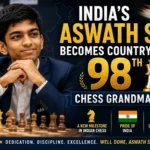
| 97 | Aswath S | India | 2026 | India’s 98th Grandmaster | Represents the newest generation of Indian chess |
| 98 | Nihal Sarin | India | 2020 | Elite Young Grandmaster | World-renowned blitz and online player |
| 99 | Raunak Sadhwani | India | 2020 | Young Elite GM | One of India’s brightest modern talents |
| 100 | Leonid Stein | Soviet Union | 1962 | Three-time USSR Champion | Influenced attacking chess despite a short career |
The Lasting Legacy of Chess Grandmasters
The greatest grandmasters are remembered for far more than tournament victories. Their influence is visible in the openings studied by club players, the endgame techniques taught by coaches, and the strategies adopted by today’s elite professionals.
Figures like Capablanca, Botvinnik, Fischer, Kasparov, Anand, and Carlsen changed the direction of chess itself. Meanwhile, countless others expanded the game’s reach through coaching, writing, streaming, commentary, and mentorship.
Modern chess has become more global than ever. Countries such as India, China, Uzbekistan, Norway, and the United States now produce world-class talent at an extraordinary pace, ensuring that the legacy of these pioneers continues through a new generation.
Key Takeaways
- Chess history has been shaped by players from every era and continent.
- World Champions remain the sport’s most recognizable figures, but many non-champions have had an equally profound influence.
- Technology, online platforms, and elite coaching have transformed how grandmasters prepare and compete.
- India has emerged as one of the strongest chess nations, producing a remarkable number of influential grandmasters.
- Influence in chess comes through innovation, inspiration, longevity, education, and contributions to the global chess community.
Frequently Asked Questions
Who is considered the most influential chess grandmaster of all time?
Many historians regard Garry Kasparov as the most influential modern grandmaster due to his dominance, opening innovations, work with computer-assisted preparation, and continued contribution to chess education.
Who is the greatest chess player in history?
There is no universally accepted answer. Garry Kasparov, Magnus Carlsen, Bobby Fischer, José Raúl Capablanca, and Emanuel Lasker are among the names most frequently included in discussions about the greatest players.
Which country has produced the most influential chess grandmasters?
Russia and the former Soviet Union have historically produced the largest number of elite grandmasters. In recent years, India, China, the United States, Norway, and Uzbekistan have become major chess powers.
Who is the most influential Indian chess grandmaster?
Viswanathan Anand is widely recognized as India’s most influential grandmaster. His five World Championship titles inspired a generation of Indian players, including Gukesh D, R Praggnanandhaa, Arjun Erigaisi, and many others.
Conclusion
The story of chess is ultimately the story of the people who have continually reinvented it. From the strategic brilliance of Capablanca and Botvinnik to the fearless creativity of Tal, the competitive dominance of Kasparov and Carlsen, and the emergence of young stars like Gukesh D and Praggnanandhaa, each generation has added something unique to the game.
While rankings will always be debated, one fact remains unchanged: the influence of these grandmasters extends far beyond trophies. They have inspired millions, advanced chess theory, and ensured that the game continues to evolve with every new generation.